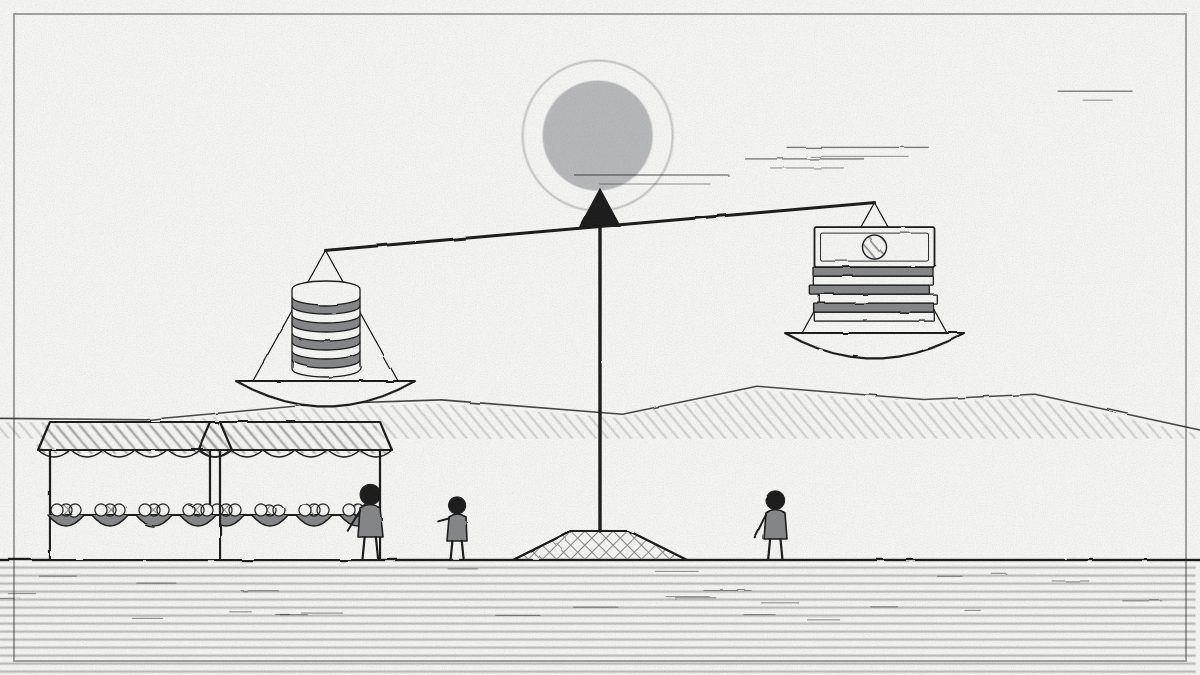
The BCC’s indicative rate moved by 0.13 per cent in May while street dollars stayed nearly two per cent dearer.
The Congolese franc barely moved in May 2021. The BCC’s indicative rate stayed between CDF 1,988.05 and CDF 1,990.66 per dollar, a range of 2.61 francs, or 0.13 per cent. Dollars sold on Kinshasa’s street, though, cost about 1.8 per cent more than the official indicative rate.
The BCC weekly digest of 28 May puts the indicative rate at CDF 1,989.40 on that day, against CDF 1,990.25 on 30 April. The calm has now lasted five months. Still, the gap between the two rates shows what is policy and what is the market.
The rest of this piece looks at who sets each price and why they differ.
A band you could draw with a ruler
The month’s high was 4 May and its low 21 May, and the two were 2.61 francs apart.
The daily series opened May at CDF 1,990.25, touched CDF 1,990.66 on 4 May, drifted down to CDF 1,988.05 on 21 May and closed at CDF 1,989.40 on 28 May. Weekly averages of the interbank rate ran at CDF 1,989.72, 1,988.55, 1,988.15 and 1,989.48.
Against the euro the picture was the same size: CDF 2,408 on 3 May and CDF 2,428 on 28 May, a rise of 0.8 per cent. The special drawing right moved from CDF 2,853.61 to CDF 2,874.49.
Since 31 December 2020, when the rate was CDF 1,971.80, the franc has lost 0.9 per cent against the dollar.
Two prices for one dollar
The official rate and the street rate use different recipes, and the difference is the spread.
The digest explains how each is built. The indicative rate is a volume-weighted average of the buying and selling rates on every transaction by the BCC, licensed banks and bureaux de change. The parallel rate is a simple average of buying and selling quotes at the main exchange places in Kinshasa.
On 28 May the Kinshasa parallel average stood at CDF 2,025, which is 1.8 per cent above the indicative rate. At the end of April the gap was 1.1 per cent, with the street at CDF 2,012. At the end of December it was 2.4 per cent, with the street at CDF 2,020. Street dollars cost about the same in francs as in January, yet the official rate rose, so the spread has narrowed over the five months and widened again in May.
What holds the middle
The BCC and the banks supply the dollars that set the official rate, so the rate depends on their stock.
A band this narrow does not happen by accident. The central bank is one of the three participants in the indicative-rate calculation, and its dollar sales and purchases weigh in it directly. For its part the BCC reported to its monetary policy committee on 27 May, according to DeskEco, that reserves had reached US$710.32 million at the end of April, up 40.59 per cent from US$505.71 million at the end of March, covering about two weeks of imports.
The digest’s later series shows the strict reserve line at US$923 million on 18 May and US$1,240 million on 28 May. A wider cushion allows the BCC to supply dollars when demand rises, which is how a band stays narrow.
The signal inside the quiet
Calm is information: it says the central bank is able to meet demand at the current price.
One reading is that the market has accepted CDF 1,990 as a fair price. The other is that the central bank has made it so. The evidence of May supports mostly the second reading, and the street spread is the test. A widening gap would show demand outrunning supply at the official rate.
The policy rate, at 10.5 per cent since 19 April, makes franc deposits cheaper to hold than they were, which weakens one reason to switch into dollars. That argument is stronger when real returns are positive, and the digest’s real policy rate was minus 1.19 per cent at the end of May.
What traders and treasurers should do
Quote and contract at the official rate, and use the street gap as an early-warning gauge.
A franc-based importer or retailer should price on the indicative rate, which has been stable, but should not extend long fixed-price promises without a margin. A treasurer who holds francs should track the gap between the Kinshasa parallel rate and the official one each week. If it widens past about 2 per cent, the calm is costing the BCC reserves faster than it is earning confidence.
Sources
- Banque Centrale du Congo – Condensé hebdomadaire d'informations statistiques n°21 (28 May 2021)
https://www.bcc.cd/statistiques/condense-informations-statistiques/2021-05-28 - Banque Centrale du Congo – Statistiques
https://www.bcc.cd/statistiques - DeskEco – RDC : les réserves de change chiffrées à 710 millions USD à fin avril 2021 (27 May 2021)
https://deskeco.com/2021/05/27/rdc-les-reserves-de-change-chiffrees-710-millions-usd-fin-avril-2021-en-hausse-de-40-par-rapport-fin - Congo Indépendant – BCC: Le taux directeur passe de 15,5 à 10,5% (16 April 2021)
https://www.congoindependant.com/bcc-le-taux-directeur-passe-de-155-a-105/


