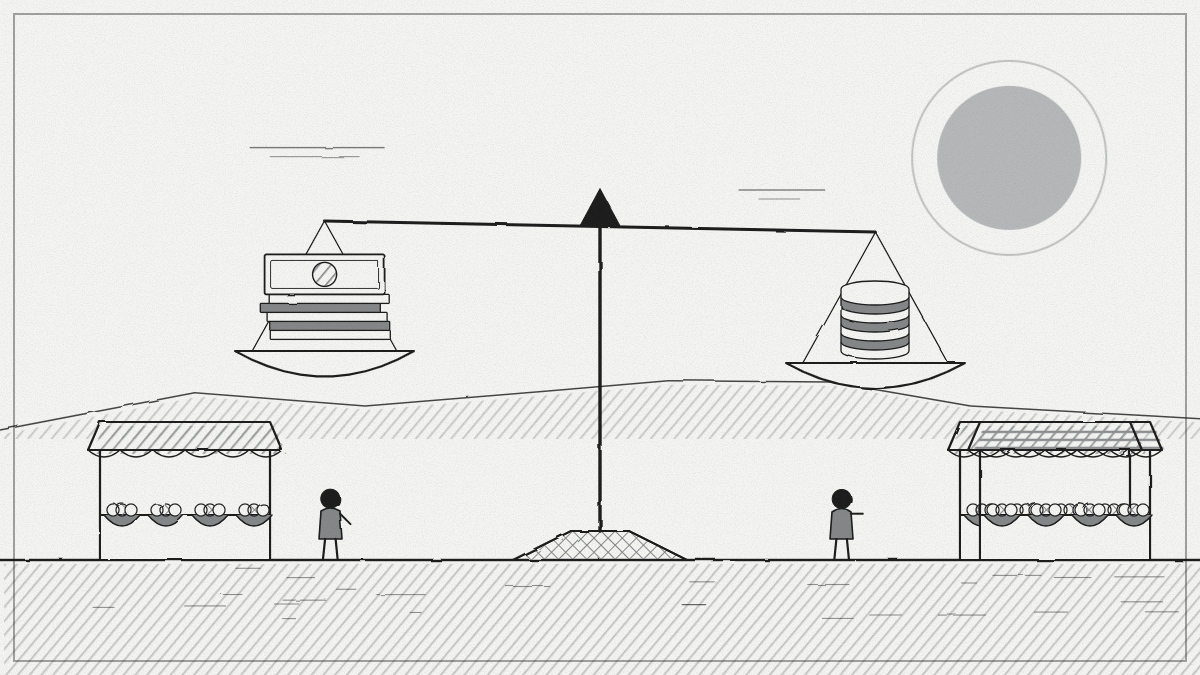
The rate barely moved; the dollar auctions behind it did.
The Congolese franc closed the BCC’s 27 April 2022 digest at an indicative rate of 2,004.57 to the dollar on 22 April, a 0.2 per cent weakening from its level at the end of March and from the end of 2021. In the same stretch the central bank booked US$89.5 million of dollar sales to banks. A currency that moved by under five francs in nearly four months did so with the central bank’s hand on it.
That is the April checkpoint: stability, but a managed kind. For anyone pricing contracts in Kinshasa or Lubumbashi, the question is how long the arrangement can run at the current pace of dollar sales.
What the rate did
The indicative rate drifted by under five francs in four months, and daily moves rarely exceeded a tenth of a per cent.
The digest shows the BCC’s indicative rate at 1,999.97 on 31 December 2021, 1,999.75 on 31 March and 2,004.57 on 22 April, a change of 0.2 per cent against both the month-end and the year-end. The daily variation column reads 0.0 or minus 0.1 for nearly every trading day of April. The BCC’s average parallel-market rate across the markets it surveys was 2,003.48 for the month to 22 April, within a franc or two of the official rate.
The Monetary Policy Committee, whose findings Actualite.cd summarised on 3 April, described the franc as stable at end-March, with the official rate at 1,999.75 and the Kinshasa parallel rate at 2,037.33. That is a spread of about 1.9 per cent, a wider gap than the survey average the digest shows, and a reminder that the two series measure different markets.
How the BCC holds the line
Dollar sales at auction, mining-revenue purchases and a 7.5 per cent policy rate do the work together.
The mechanism is a loop. Mining companies pay taxes and royalties in dollars, and the BCC buys them: US$246.0 million of mining revenue in March, and US$107.3 million in the first 22 days of April, according to the digest’s foreign-exchange account. It then sells dollars to commercial banks at its interbank auctions, US$71.0 million in March and US$89.5 million so far in April, against franc demand from importers. Each auction takes francs out of circulation and puts dollars into the market at a price the BCC prefers.
The committee kept the policy rate at 7.5 per cent and said it would monitor the foreign-exchange market closely, as the Actualite.cd summary reports. The same summary notes that the budget was executed without recourse to central-bank financing, which removes the other source of franc pressure.
What the cost of stability looks like
Auction sales have risen each month, and reserves cover only a little more than two months of imports.
The BCC sold about US$56 million of dollars in January, US$66.5 million in February, US$71.0 million in March and US$89.5 million to 22 April. April is not finished, and the pace is already above any month this year. International reserves were US$2,960.4 million on 22 April, 2.58 months of imports, up from US$2,739.3 million at the end of March after a jump of about US$210 million between 15 and 18 April that the digest does not explain.
The cover from mining receipts has narrowed sharply. March purchases of US$246.0 million were more than three times that month’s auction sales; April’s US$107.3 million of purchases so far is only 1.2 times the US$89.5 million sold. The BCC’s exchange-rate page is the series to watch for the first widening of the gap between official and market rates, which would signal that auctions are being rationed.
What a business should do with the checkpoint
Price in dollars but hold francs for tax and wages, and build in a gap clause.
The franc’s stillness is cheap to rely on and costly to misread. A business that bills in dollars and pays wages or tax in francs is exposed to a change in the arrangement, not to the present rate. Contracts should state the franc rate used, the BCC indicative rate being the natural reference, and carry a clause that reopens the price if the gap between that rate and the market exceeds a few per cent. A treasurer who writes that clause now will not have to renegotiate under pressure when the auctions are rationed.
Sources
- Banque Centrale du Congo – Condensé hebdomadaire d'informations statistiques n°16 (27 April 2022)
https://www.bcc.cd/statistiques/condense-informations-statistiques/2022-04-27 - Actualite.cd – RDC : le Comité de Politique Monétaire de la BCC note une stabilité du taux de change (3 April 2022)
https://actualite.cd/2022/04/03/rdc-le-comite-de-politique-monetaire-de-la-bcc-note-une-stabilite-du-taux-de-change-une - Banque Centrale du Congo – Cours de change (series page, official exchange rates)
https://www.bcc.cd/statistiques/secteur-exterieur/cours-de-change - Banque Centrale du Congo – Marché des changes (series page, foreign-exchange operations)
https://www.bcc.cd/statistiques/secteur-exterieur/marche-des-changes


