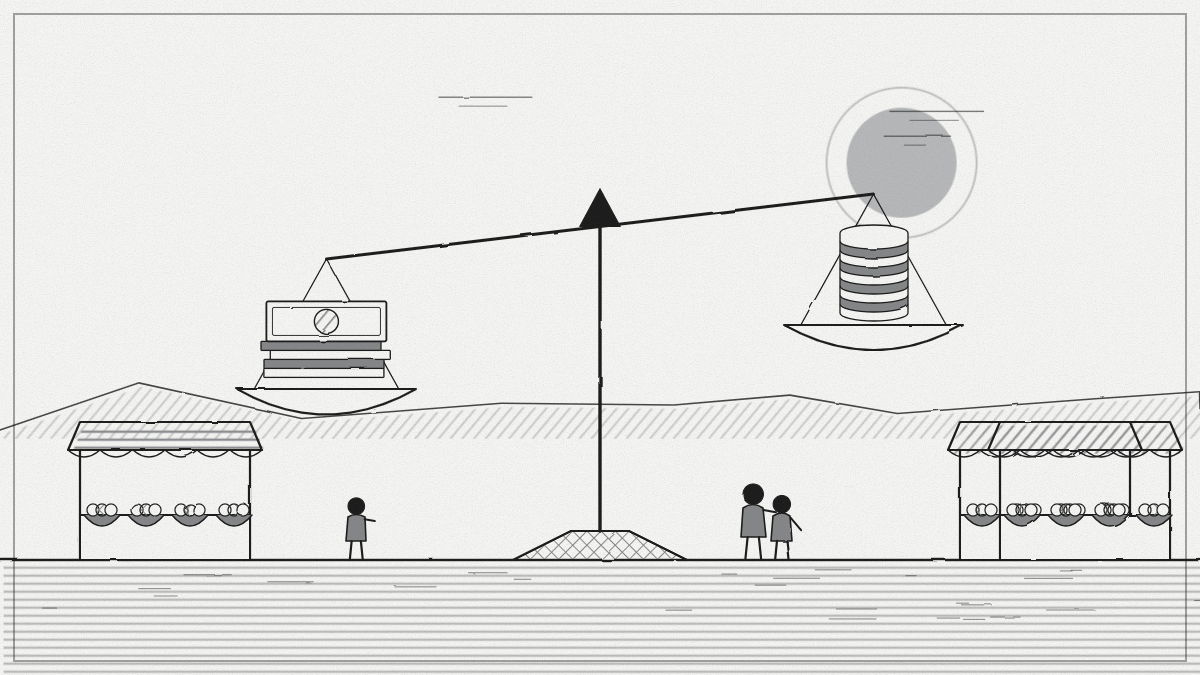
The franc did not collapse in May, it converged, and the official rate did the travelling.
By 19 May 2023 the Banque Centrale du Congo’s indicative rate stood at CDF 2,317.59 to the dollar, and the street quote in Kinshasa was CDF 2,352.13. The gap between them was 1.5 per cent. On 24 March it was 13.6 per cent. In eight weeks the franc’s two prices, the official and the parallel, had met, and almost all the travelling was done by the official one.
That is the real May story. The BCC digest of 24 May shows a franc 13 per cent weaker than at the end of 2022 on the official measure, and barely moving on the street. The currency did not collapse in May. It converged.
The month in numbers
The indicative rate rose from CDF 2,222.59 on 2 May to CDF 2,317.59 on 19 May, with two violent days in between.
The month opened at CDF 2,222.59 after an April in which the rate had gone from CDF 2,036 to CDF 2,230.64. It reached CDF 2,273.93 on 5 May, then eased to CDF 2,259.92 on 8 May. On 9 May it dropped to CDF 2,178.92, an appreciation of 3.7 per cent on the day, and on 10 May it bounced back to CDF 2,272.48, a depreciation of 4.1 per cent. By 19 May it had settled at CDF 2,317.59.
Two-way swings of that size were absent from the stable first quarter, when the rate moved by about one per cent between January and mid-April. Their arrival signals a market in which trading volume, not an administrative price, sets the rate. The BCC defines the indicative rate as a volume-weighted average of buying and selling rates from the central bank, authorised banks and bureaux de change, and one thin day can move it.
The street barely moved
The parallel market rose 1.6 per cent in eight weeks while the official rate rose nearly 14 per cent.
The Kinshasa parallel rate was CDF 2,314.38 on 24 March, CDF 2,338.50 on 28 April, CDF 2,351.25 on 12 May and CDF 2,352.13 on 19 May. Over the same eight weeks the indicative rate climbed from CDF 2,036.95 to CDF 2,317.59.
Deskeco’s report of 15 May quoted the central bank saying the exchange rate had remained stable on the market at CDF 2,345 to the dollar between 3 March and 5 May. The digest’s street series agrees. What changed was the official price, which closed the distance.
Why the gap mattered
A cheap official dollar was a subsidy to whoever could get one, and it has been priced away.
For eight weeks in March and April, a business with access to bank dollars at CDF 2,037 and street customers paying CDF 2,314 for their goods would have earned a spread of 13 per cent on the exchange rate alone. That spread ended in May. Importers who bought dollars at the official rate now pay within 1.5 per cent of the street price, so the advantage has gone.
The central bank’s other levers stayed where they were. The policy rate was 9.00 per cent in the BCC’s tables through 19 May, with year-on-year inflation at 20.2 per cent nationally and 26.4 per cent in Kinshasa. Reserves were US$4,169.11 million, or 2.25 months of imports, a little above the US$4,098.58 million of 21 April.
What the IMF added
A staff-level agreement on 3 May kept the programme and its disbursement on track.
An IMF team led by Mercedes Vera Martin met the authorities in Kinshasa between 19 April and 3 May and reached staff-level agreement on the fourth review of the Extended Credit Facility. Board consideration was expected by the end of June, and completion would make SDR 152.3 million available for balance-of-payments support.
What a business should do
Price at CDF 2,300, track the gap weekly, and plan for both rates to rise together.
The gap has closed, so a firm that invoices in francs and holds dollar costs should set its internal conversion rate at about CDF 2,300, not at the CDF 2,037 of the first quarter. Treat any day on which the indicative rate moves more than two per cent as noise and wait for the weekly average before repricing.
The risk is that the next move is for both rates to rise together. With inflation at 20 per cent, the franc has reason to lose more ground. Contracts should carry a dollar reference or a monthly reset, and treasuries should hold the dollars they will need for the next quarter’s imports now.
Sources
- Banque Centrale du Congo – Condensé hebdomadaire d'informations statistiques, semaine au 19 mai 2023 (24 May 2023)
https://www.bcc.cd/statistiques/condense-informations-statistiques/2023-05-24 - Deskeco – RDC : le taux de change est resté stable sur le marché entre le 3 mars et le 5 mai 2023 à 2.345 FC pour 1 dollar américain (15 May 2023)
https://deskeco.com/2023/05/15/rdc-le-taux-de-change-est-reste-stable-sur-le-marche-entre-le-3-mars-et-le-5-mai-2023-2345-fc-pour-1 - IMF – IMF Team Reached Staff-Level Agreement with the DRC on the Fourth Review of the Extended Credit Facility (3 May 2023)
https://www.imf.org/en/news/articles/2023/05/03/pr23132-imf-team-reached-staff-level-agreement-on-review-of-arrangement-under-the-ecf - Banque Centrale du Congo – Statistiques (statistics portal)
https://www.bcc.cd/statistiques


