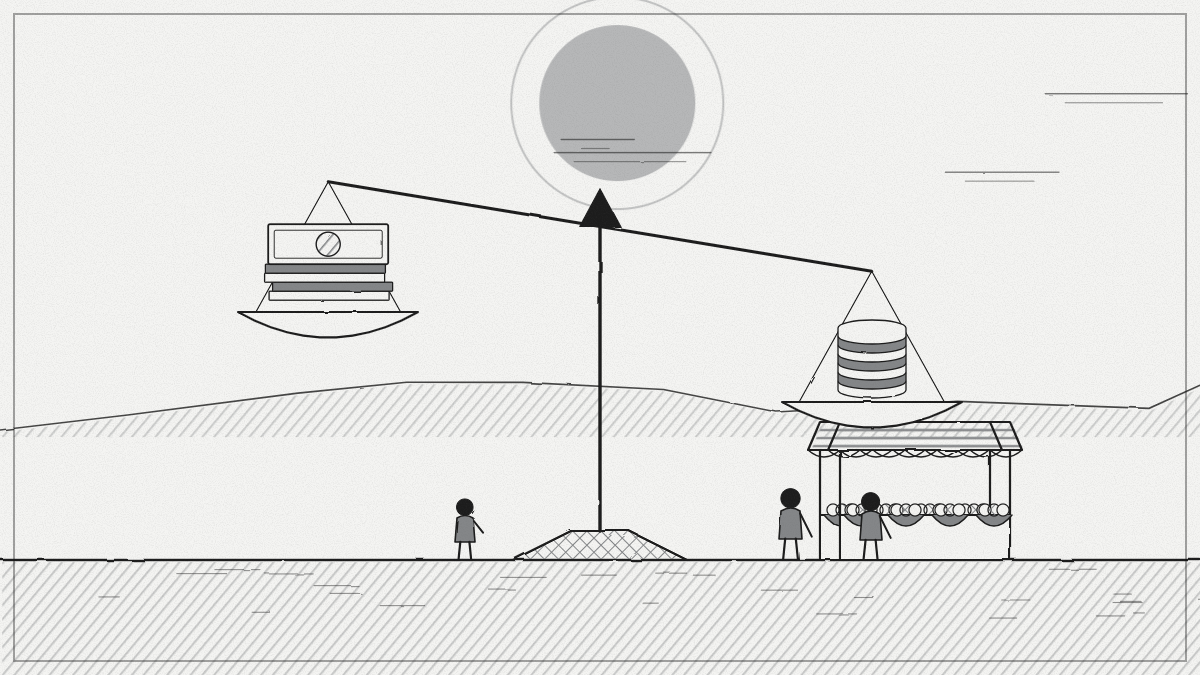
A 0.7 per cent nominal slide against 10 per cent inflation turns the November rate into a real appreciation.
The franc ended November almost where it began the year. The BCC’s indicative rate was 2,013.97 to the dollar on 25 November, a depreciation of just 0.7 per cent since December, according to the central bank’s weekly digest. Prices inside Congo over the same period rose by about 10 per cent nationally and 12 per cent in Kinshasa.
A flat nominal rate and rising local prices add up to a real appreciation, and that is November’s checkpoint. The franc buys no more dollars than before, but a franc-priced Congolese product has become dearer against a dollar-priced import.
The rate that did not move
Official and street quotes both stayed close, with a gap of about four per cent.
The indicative rate was 2,012.39 on 30 September and 2,012.75 on 31 October. On the Kinshasa street the dollar cost 2,095.00 francs on 25 November, a premium of 4.02 per cent, practically unchanged from the 3.97 per cent of late October. Elsewhere the street paid 2,042.50 in Lubumbashi, 2,050.00 in Goma, 2,070.00 in Kananga and 2,075.00 in Kisangani. The premium has stopped widening, which is itself news after a year in which it opened from under two per cent. The BCC’s table of year-to-date change shows the franc down 0.6 per cent at the end of September and October and 0.7 per cent by mid-November, small enough to read as a managed anchor rather than a market price.
Reserves improved gently. The BCC’s series reached US$3,991.2 million on 25 November, equal to 2.39 months of imports, up from US$3,920.0 million at the end of September. The Fund had just given its blessing: on 18 November the IMF announced a staff-level agreement on the third review of the Extended Credit Facility, with 152.3 million SDRs, about US$200 million, to be released once its board agreed. It also projected growth of 6.6 per cent for 2022 and inflation above 12 per cent by the end of the year.
Where the dollars come from
Mining receipts supply the foreign exchange, and one large mine shows the scale.
The franc’s calm depends on a flow of export dollars into the banking system. A single operation illustrates the order of magnitude. Ivanhoe Mines reported that its Kamoa-Kakula complex sold a record 93,812 tonnes of payable copper in the third quarter and recognised revenue of US$460.5 million. The BCC’s own foreign-currency budget shows mining-related purchases of about US$93 million in the November column to 23 November, against a balance that remains negative at about US$115 million.
The flow matters because Congolese demand for dollars is large and constant: imports of fuel and food, military purchases that the BCC table lists at US$53.5 million to 23 November, and the dollar-quoted payrolls of banks, telecoms and mines. The system works while receipts keep pace with that demand.
The real exchange rate nobody is quoting
A steady nominal rate with ten per cent inflation makes imports a bargain against local goods.
Weekly price data show cumulative inflation of 9.85 per cent nationally and 12.07 per cent in Kinshasa since the end of December. Before allowing for American inflation, which also pushes dollar prices up, that implies a real appreciation of roughly nine per cent nationally and eleven per cent in Kinshasa against the dollar. An imported bag of flour, priced in dollars and converted at a fixed rate, has risen less in francs than a locally milled one.
That asymmetry favours importers and consumers of imported goods and hurts producers who sell in francs and carry costs that rise with local wages, rents and transport. It also lowers the franc cost of dollar debts, which is a quiet gift to borrowers in foreign currency.
What a treasurer or a producer should do
Price in dollars where you can, and hedge the franc side of your costs.
Producers selling in francs should review their price lists against their cost index, not against the exchange rate. A fixed rate gives no cover against a cost base that has risen ten per cent, and a local competitor with the same cost base has no cover either, so the pressure falls on margins across the sector. Where customers accept dollar pricing, or a franc price indexed to the indicative rate, the squeeze eases.
Importers have a window. With reserves at 2.39 months and a premium that has stopped widening, the cost of a dollar has rarely been more predictable. Fix the next two quarters of supplier contracts now, because that predictability depends on a reserve cushion of well under three months.
Sources
- Banque Centrale du Congo – Condensé hebdomadaire d'informations statistiques n°47 (30 November 2022)
https://www.bcc.cd/statistiques/condense-informations-statistiques/2022-11-30 - International Monetary Fund – Les services du FMI parviennent à un accord au niveau des services avec la République démocratique du Congo sur la troisième revue de la Facilité élargie de crédit (18 November 2022)
https://www.imf.org/fr/news/articles/2022/11/18/pr22395-democratic-republic-congo-imf-staff-reach-staff-level-agreement-third-review-under-ecf - Ivanhoe Mines – Ivanhoe Mines Issues Third Quarter 2022 Financial Results, and Review of Mine Construction and Exploration Activities (14 November 2022)
https://www.newsfilecorp.com/release/144113 - Banque Centrale du Congo – Statistiques
https://www.bcc.cd/statistiques


