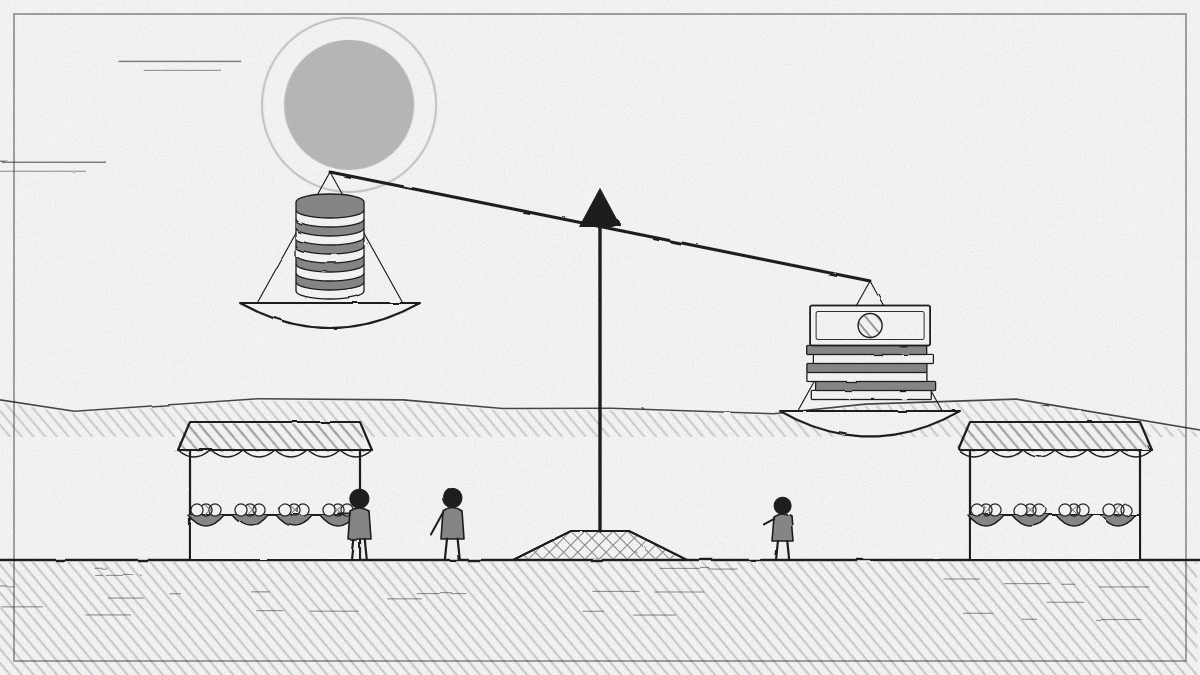
Official rate 3.4 per cent weaker in three weeks, and the 25 per cent rate no longer compensates.
The Congolese franc stopped firming in October 2023 and began a slow, steady slide. The Banque Centrale du Congo’s digest of 25 October, covering the week to 20 October, puts the official indicative rate at 2,536.50 francs per dollar, against 2,453.90 at the end of September and 2,016.57 at the end of 2022. That is 3.4 per cent weaker in three weeks and 25.8 per cent weaker in ten months.
The change in character matters more than the level. September’s rate zigzagged by 11 per cent in a session; October moved in a narrow, one-directional channel, and the policy rate of 25 per cent that was meant to anchor the currency now earns less than the franc loses.
A drift, not a spike
Daily quotations rose in a tight band from 2,462 to 2,543, with almost no reversals.
The opening quotation was 2,487.16 on 2 October, dipped to 2,461.79 on 3 October, and then climbed: 2,503.16 on 6 October, 2,500.55 on 12 October, 2,535.56 on 18 October and 2,543.02 on 19 October. The weekly averages in the digest’s market table read 2,488.8, 2,500.3 and 2,538.0. September’s sixteen quotations had a range of 285 francs; October’s range was 81.
A quiet market with a one-way slope is the pattern of steady dollar demand meeting steady franc supply, not of panic. Panics are loud; drifts erode a balance sheet unnoticed.
The reserves behind the rate
Reserves of US$4,598 million cover 2.48 months of imports, down US$135 million since the end of August.
The BCC’s series shows reserves of US$4,733 million on 31 August, US$4,652 million on 29 September and US$4,598 million on 20 October, which is 2.48 months of imports. That is still above the US$4,349 million of December 2022, but the cushion has narrowed in every reading since the July high of US$5,012 million. The pace of decline slowed in October, falling about US$54 million in three weeks against US$81 million in September.
External prices did not help. Copper, quoted on the London Metal Exchange, stood at US$7,879.61 on 20 October, 6.0 per cent below its end-2022 price, while Brent was US$91.30, up 6.2 per cent. Cobalt held near US$32,800.
The carry arithmetic
A 25 per cent policy rate pays 1.4 per cent over three weeks; the franc lost 3.4 per cent in the same time.
Here lies the mechanism that treasurers should watch. The BCC’s seven-day bill, the floor for franc interest rates, yields 25 per cent a year, or about 0.48 per cent a week. Over the three weeks from 29 September to 20 October that is 1.4 per cent, set against a depreciation of 3.4 per cent. Holding francs in bills therefore lost about two points in dollar terms, and a company with spare francs was better off converting. The Monetary Policy Committee had held the rate at 25 per cent on 18 September and said it stood ready to tighten further.
That is an unstable position. When the tightening instrument pays less than the depreciation, the incentive to buy dollars returns, and the BCC must either add to the rate, draw on reserves or accept the drift.
What the drift costs in prices
The national index rose 27.3 per cent since December, and cassava and its relatives are 27 per cent dearer than at the end of July.
The weekly national price rise in the digest’s last week was 0.57 per cent, with 1.6 per cent in October to date and 27.3 per cent since December. The tuber, cassava and banana group went from 282.770 in the week to 30 July to 359.654 by 20 October. A 3.4 per cent move in the exchange rate over three weeks feeds imported goods almost directly, because wheat, fuel, medicines and packaging are paid for in dollars. August’s rate decision was meant to neutralise excess liquidity, and the October slide shows how much of it remains.
What a treasurer does with the October signal
Convert francs sooner than the invoice requires, and price renewals with a clause tied to the indicative rate.
Companies holding francs above immediate needs should convert in weekly tranches, not wait for month-end. Suppliers invoicing in francs should link renewals to the BCC’s indicative rate with a review trigger at a 2 per cent move. Importers should note that the central bank still has US$4.6 billion to defend with, so a sharp break looks unlikely, but a persistent drift of about one per cent a week is entirely consistent with the data. The numbers to watch in the next digests are the daily range, which signals calm, and the reserve line, which signals the cost of calm.
Sources
- Banque Centrale du Congo – Condensé hebdomadaire d'informations statistiques n°42 (25 October 2023)
https://www.bcc.cd/statistiques/condense-informations-statistiques/2023-10-25 - African Development Bank – Democratic Republic of Congo news keyword page
https://www.afdb.org/en/news-keywords/democratic-republic-congo - Sikafinance – RD Congo : Malgré un repli de l'inflation, la banque centrale maintient son taux directeur à 25% (14 October 2023)
https://www.sikafinance.com/marches/rd-congo-malgre-un-repli-de-linflation-la-banque-centrale-maintient-son-taux-directeur-a-25_43078 - Actualite.cd – La BCC relève son taux directeur de 11% à 25% pour neutraliser l'excès de liquidité (9 August 2023)
https://actualite.cd/2023/08/09/la-bcc-releve-son-taux-directeur-de-11-25-pour-neutraliser-lexces-de-liquidite-et


